I – finally – finished – Chrono Cross.
Phew!… That sentence alone feels like an accomplishment, especially considering how many times I started the original Playstation version and never made it past the first time jump. There was always some other game that would nab my attention away. If I had spent the same amount of time playing the game as I had spent watching the intro FMV, I may have gotten a fair way into it. Sorry, but not sorry. That song is a banger.
But this year, I went ahead and purchased Chrono Cross: The Radical Dreamers Edition with the intent to finish it. It took me about 50 hours to complete a full playthrough, and… I have some things to say.

First off, I want to get one thing out of the way. Radical Dreamers Edition is the definitive way to play in my opinion, but it does require some work. We’ll get into that in a bit.
I had always heard that Chrono Cross was only loosely tied to Chrono Trigger, with only one or two sparse references. But that’s not really accurate. There was a lot more connecting the two games than I had expected, and some of it went pretty deep. Familiar names, familiar timelines, and a few characters from the original show up in unexpected ways. It really did feel like a sequel to me, even though the gameplay and style was fairly different. One of the biggest differences was in the writing style, which had a tendency to lean heavy handedly into full-blown existential dread sprinkled with a lot of multiverse confusion. It was a little too much at times, even for someone like me who enjoys that type of writing. You can feel the game reaching for something profound, and occasionally it lands, but a few times it just felt like it was trying to be too deep. I’m probably making this sound a little too negative, but bear with me.
The character roster is also absurd, for better or worse. The 44 characters (excluding the permanent main protagonist) that you can add to your party seems overwhelming, especially when you realize some of the very specific actions you have to take to recruit some of them. Let alone the fact that some of those characters just aren’t that great. Overall, it’s more likely that you are going to find a few characters you like and stick with them through most of the game, which is pretty much what I did. Every once in a while you’ll have to swap them around if one of them leaves, or you have a task that requires a specific member to be in the active trio. Kid, Fargo, and Harle stood out as the more memorable team-mates, and there’s a good section of the story involving Nikki, though I somehow missed the chance to recruit him. The rest seemed more like background noise, at least in this playthrough. Some characters had their moments in the main plot, but usually too brief to make any major impact on me. But it’s extremely likely that I just missed bigger sections of their storyline. Take Sprigg for example, who I used frequently and can be very OP with her Dopplegang ability, but generally had that “Just someone I picked up along the way” vibe the entire time.

Combat takes some getting used to. It’s a weird blend of stamina management, elemental grids, and traditional JRPG flow. I collected some traps, but never used them due to the amount of pre-planning needed. I managed to launch a few summons, but the requirements to cast them were a bit of a pain. The best thing I learned was how to over-budget stamina by casting elements using the last point in an attack chain, which made combat way easier. If you haven’t played before, I’m sure that was all very confusing, and the game honestly does a terrible job of explaining itself. You’ll definitely want to look up some of the many tips and guides on Youtube.
Difficulty-wise, Chrono Cross isn’t very hard. The standard enemies were usually easy, nothing felt unfair save for a few bosses that KO’d my entire party with a single spell cast (at full health I might add). I’ll admit that I did exploit the dodge-everything “enhancement” once to get past a particularly annoying boss, but I played it straight for the rest of the game. One thing I appreciated was the leveling system. It doesn’t force you to grind endlessly like a lot of JRPGs. What was odd was how you have hard caps between boss fights. I’m sure that annoyed some people, but for me, it wasn’t a bad thing. I feel like the game respected my time without letting me get too strong too early.
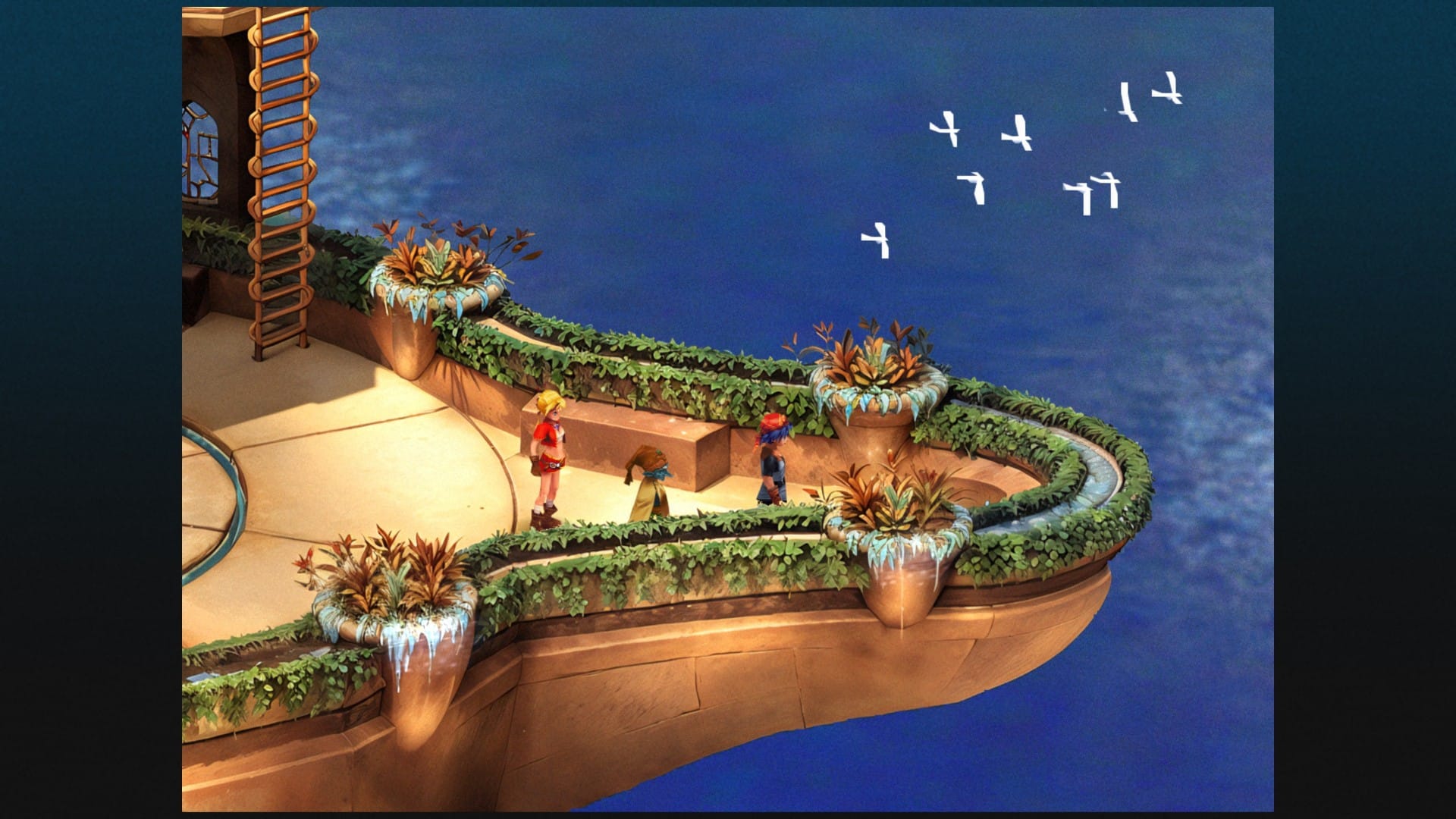
The PC remaster got a lot of harsh reviews early on, and it’s honestly still a mixed bag. The newer character models look much better that the original PS1 versions, and the 60 fps battles are a huge improvement. But the backgrounds… yikes! Square-Enix tends to have a bad habit of using ugly-as-sin upscaling methods when they “remaster” an older title, and it certainly didn’t do this game any favors. Fortunately, you have things like the Zeitgeist HD Background Upscale mod, which used higher quality AI upscaling to make massive improvements to the visual quality. With that, the game actually looks like a proper semi-modern remaster.
Visually, I still think the game has a ton of charm. A lot of people were upset that it didn’t have the art of Akira Toriyama like Chrono Trigger did. But instead they used Nobuteru Yūki for character design, another favorite artist of mine who worked on Record of Lodoss War, Battle Angel Alita, and Seiken Densetsu 3 (aka Trials of Mana). The characters in Chrono Cross are bright, expressive, and deceptively cheerful considering how dark the story writing could be at times. The environments are also rich and colorful thanks to art director Yasuyuki Honne. It’s one of those games that’s just beautiful to look at, even when it’s being emotionally devastating.

The music was also incredibly well written thanks to Yasunori Mitsuda, who also worked on the original Chrono Trigger with Nobuo Uematsu, as well as several other popular titles like Xenogears and the more recent Sea of Stars. There was a lot of variety between different areas throughout the game and various sections of the story. I did find it getting a little too repetitive during enemy encounters, but I suppose that’s to be expected with just about any JRPG.
There are also some really cool quality-of-life features added in the Radical Dreamers Edition. Speed-up was great for cutting through long casting animations and backtracking through different areas, and auto-battle helped on those rare occasions where I actually needed to level grind on easier enemies. I felt like the whole experience was a lot better being able to quickly toggle those options on and off as needed.
Getting everything stable, on the other hand, was a huge chore. After installing the HD background mod, the micro-stuttering issues increased to the point of being obnoxious. Several times early on I couldn’t even launch the game. At one point several hours in, the game started crashing to desktop every few minutes. After hours of searching through Reddit and Steam discussions I finally dug through my GPU settings and disabled every enhancement one by one. It took a lot of trial and error to figure out, and far more effort than I’d normally commit to. Fortunately, once it was fixed, it was fixed, and it ran smooth as silk ever since.
Now that I’ve completed the first playthrough, I can say I’m glad I got through it. Much of that is because of how long it had sat unfinished in my backlog. To me there’s a lot of value in seeing a game through, even if the payoff isn’t life-changing. Chrono Cross is a strange, beautiful, and sometimes ‘too deep for its own good’ game. But it has charm for sure. It’s a step down in some ways from Chrono Trigger, a sideways leap in others. Where it does tie to its origins in Chrono Trigger, it does so in a similar way as The Force Awakens trilogy did with Star Wars (which I kinda hated, so maybe not a great example?). Chrono Cross aimed to be something different, and for that, I respect it, even if I didn’t love every minute.
Would I recommend it? Sure. If you’re the kind of player who wants to see the full Chrono series conclusion, it’s worth the time. Just go in with the understanding that you’re not getting Chrono Trigger 2. Otherwise, the journey is still a worthy one. You’re getting something bolder, darker, and downright confusing at times. And sometimes, that’s okay.